
Articles

The optimism that accompanied the beginning of President Amine Gemayel’s term after his election in 1982 did not last. Security and political pressures quickly weighed on Lebanon’s economy again while the country was still emerging from the effects of the Israeli invasion.

The Mountain War, displacement and emigration placed major pressure on the economy and the lira. GDP fell by about 25 percent in 1983, while the balance of payments recorded a $950 million deficit—the first since 1976. The lira weakened from roughly 3.80 to the dollar at the end of 1982 to 5.50.

Pressure increased when the Palestine Liberation Organization left Lebanon and more than $1.5 billion departed with it. The economy thereby lost foreign-currency inflows that had entered the country indirectly in support of the Palestinian resistance.

The state, meanwhile, continued spending foreign currency on essential and military needs. It paid around $900 million to arm the military, and foreign-currency payments for weapons, wheat, fuel and other purchases totaled about $2.03 billion in 1983 and 1984. Banque du Liban’s reserves consequently fell below $650 million by the end of 1984.

A growing dispute emerged over the boundaries between the state and Banque du Liban. Critics argued that the government treated the central bank as a readily available source of financing, while Governor Michel Khoury warned of the consequences of continuing on that path.

Dr Edmond Naim was appointed governor of Banque du Liban on January 15, 1985. Taking office during an exceptionally difficult financial period, he began by insisting on compliance with the Code of Money and Credit and limits on uncontrolled financing of the state.

The leadership of the monetary authority also changed when Dr Hussein Kanaan became first vice-governor, the first member of the Shiite community to hold the position, reflecting the political and sectarian changes taking place across the country.

The financial crisis was inseparable from political collapse. The national unity government disintegrated, state institutions became paralyzed and no general budget was in force. The dollar reached 18 lira by the end of 1985, while state revenue covered no more than 14 percent of expenditure.

Faced with this deficit, the government again turned to Banque du Liban, seeking the transfer of revaluation gains on gold and foreign currencies and financing for its needs. Naim refused to treat exchange-rate differences as real, spendable profits, warning that further liquidity would increase pressure on the lira and deepen its depreciation.

Banque du Liban had financed about 78 percent of the state’s needs, but Naim refused to raise the lending ceiling. He relied on the Code of Money and Credit, which permits the central bank to finance the state within limits that do not harm monetary stability but does not require it to do so.

The dispute extended to fuel, whose subsidized prices consumed resources exceeding twice the state’s revenue. As the crisis escalated, Prime Minister Rashid Karami brokered a compromise under which Banque du Liban agreed to finance only public-sector salaries and essential supply needs.

By the mid-1980s, Banque du Liban had entered a new phase. Protecting the lira from war was no longer its only challenge; it also had to draw clear boundaries between the state’s financing needs and the independence of monetary policy. This confrontation between fiscal and monetary authorities became one of the defining chapters of Lebanon’s crisis in the second half of the decade.
In the early 1970s, Lebanon was at the height of its financial and banking prosperity. Beirut had become a regional business center and market liquidity reached unprecedented levels. Lebanese banks financed institutions and governments abroad—including Algeria, Renault and the International Bank for Reconstruction and Development—reflecting the confidence then placed in the Lebanese lira and banking sector.

Despite the abundance of funds, the Lebanese state refused to embrace a policy of borrowing. Banks reportedly tried to persuade President Suleiman Frangieh to issue Treasury bonds to absorb excess liquidity, but he refused, saying that he lived within his means and had no need to borrow.

Warning signs were growing beneath the prosperity. By the end of 1974, banks’ consolidated balance sheets were equivalent to about 110 percent of GDP, a scale beyond the real economy’s capacity. Banque du Liban Governor Elias Sarkis feared that a more turbulent period was approaching.

As political tensions rose, Banque du Liban considered moving its gold reserves to a safer location. The plan was postponed because of logistical difficulties and concern that moving the gold would undermine confidence in the Lebanese lira.

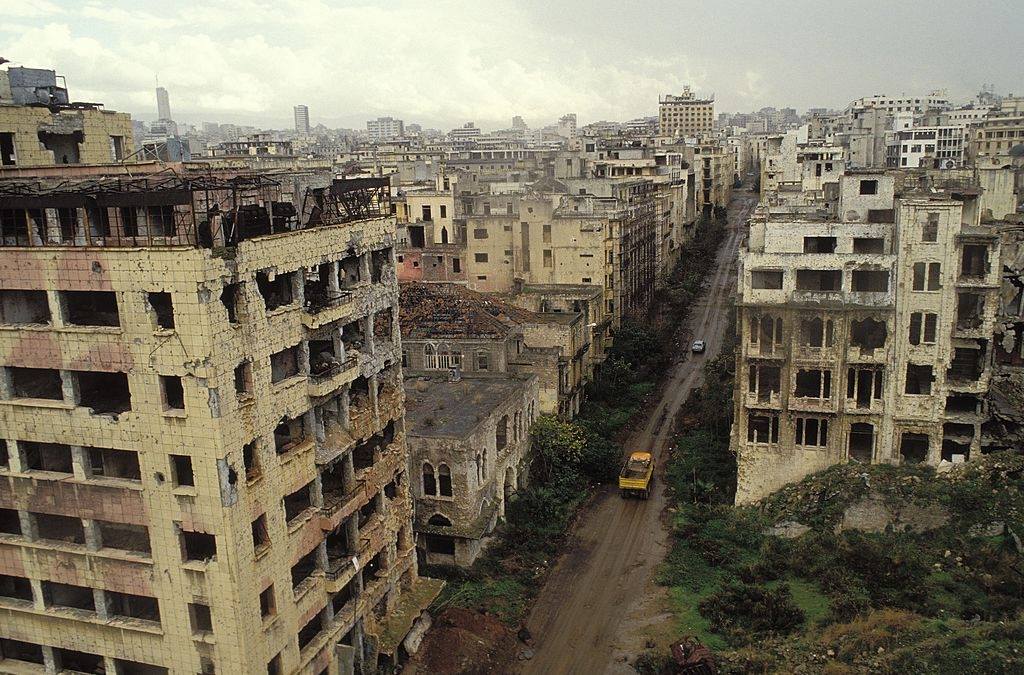
Civil war erupted in spring 1975 and quickly destroyed the country’s image of stability. Beirut’s commercial center was devastated, tax collection stopped, ports and public institutions were damaged, and GDP fell from $3.4 billion in 1974 to about $2.1 billion in 1976. The fiscal deficit reached unprecedented levels.

Although Banque du Liban’s building stood in West Beirut and militias targeted it during the fighting, the central bank remained outside the direct conflict. Political and security contacts prevented it from being stormed, protecting the gold and foreign-exchange reserves that represented the country’s last pillars of financial stability.

Elias Sarkis was elected president in 1976 after years leading Banque du Liban. Together with Prime Minister Salim Hoss and Finance Minister Farid Roufael, he formed a team that worked to protect the banking sector and keep it operating despite the war.

By 1977, Banque du Liban had launched what became known as the “second financial correction,” following the reforms adopted after the Intra crisis. It granted banks exceptional credit, lowered discount and mandatory-reserve rates, and facilitated debt rescheduling in an effort to support the economy, finance reconstruction and preserve the lira’s exchange-rate stability.

Michel Khoury became governor of Banque du Liban in September 1978 and faced renewed war, Israel’s invasion of the south and escalating internal conflict. As speculation in the lira and property expanded, the central bank raised the mandatory reserve ratio to 15 percent and used Treasury bonds to absorb excess liquidity and curb currency speculation.

Despite the war, the banking sector continued to record striking growth. Deposits rose from about $3 billion in 1976 to nearly $12 billion in 1982. Banque du Liban’s gold and foreign-currency reserves exceeded $2 billion, while Lebanese banks expanded their networks at home and abroad.

Israel’s June 1982 invasion dealt the economy a severe blow. Extensive infrastructure was destroyed and major economic and banking centers were damaged. Banque du Liban intervened to protect its branches, preserve account secrecy and prevent interference with accounts during the military operations.

Bachir Gemayel’s election as president briefly revived hopes of ending the war, but his assassination weeks later returned the country to violence. Under President Amine Gemayel, Banque du Liban maintained reserves above $2.6 billion and transferred substantial profits to the Treasury. Yet the cost of the Israeli invasion, rising public debt and deteriorating state finances had already placed Lebanon on a new economic path that would lead gradually toward the collapse of the 1980s.

The years from 1974 to 1982 therefore carried Lebanon from the height of financial strength to the beginning of its erosion under the weight of war. They formed the final chapter of the age of prosperity and the opening of a long period of economic and monetary challenges.

Intra Bank’s collapse in October 1966 was the most serious banking crisis in modern Lebanese history, but it also became a turning point that reshaped the roles of the state and Banque du Liban in regulating the financial sector.

The crisis began when Youssef Beidas, who was outside Lebanon, refused to return to sign the bank’s balance sheet. Intra’s board also refused legal responsibility for its financial statements, prompting the Council of Ministers to withhold the requested liquidity even though it knew this would effectively cause the bank to suspend payments.

Intra closed its doors on October 15, 1966 amid widespread panic among depositors. It held roughly 15 percent of all bank deposits in Lebanon, placing the entire sector at risk of collapse.

Within days, President Charles Helou and the government adopted exceptional measures: banks were temporarily closed, immediate liquidity was injected and fifty million lira was secured for small depositors. Major amendments to the Code of Money and Credit created the Banking Control Commission, the Higher Banking Commission and the National Deposit Guarantee Institution, while granting monetary authorities the power to take control of troubled banks.

Lebanon had barely moved beyond the shock of Intra when the June 1967 war caused another banking panic. The government closed banks for four days and limited each depositor’s withdrawals to one thousand lira.

Elias Sarkis became governor of Banque du Liban in June 1967 and led the restructuring of the banking sector and the effort to save Intra from complete bankruptcy. That October, major creditors became shareholders in Intra Investment Company, capitalized at 280 million lira, while the company retained strategic assets including shares in Middle East Airlines and Casino du Liban.

By 1968, confidence was gradually returning. Consolidation reduced the number of banks from 88 to 72, deposits rose to 3.65 billion lira and the dollar remained stable at about 3.17 lira.

Under Sarkis, Banque du Liban made the strategic decision to increase its gold holdings. Between 1970 and 1971, the central bank accumulated more than 9.2 million ounces at the official price of $35 per ounce, only days before US President Richard Nixon suspended the dollar’s convertibility into gold—a decision followed by a sharp rise in the metal’s price.

Lebanon experienced one of its most prosperous periods between 1970 and 1974. Oil prices rose, Arab capital flowed into Beirut and the city became a regional financial and media center. Banks’ consolidated balance sheets grew by 226 percent in six years, while Lebanon recorded budget and balance-of-payments surpluses.

Warning signs nevertheless appeared beneath the prosperity. Banque du Liban observed an unusual rush into the Lebanese lira and a decline in the dollar’s price. It later emerged that armed groups and regional states had been accumulating large amounts of Lebanese currency ahead of the period that preceded the 1975 war.

In less than a decade, Lebanon moved from the brink of banking collapse after the Intra crisis to the height of financial and monetary prosperity. Many regarded it as the economy’s golden age, even though it already contained the seeds of the upheavals that would soon erupt.

Lebanon’s gold reserve is one of the state’s most important strategic assets. Official holdings total about 286.8 tonnes, or approximately 9.9 million ounces. This places Lebanon twentieth worldwide by the size of its gold reserve and second among Arab countries after Saudi Arabia.

The stock is divided between Lebanon and the United States. About 6.6 million ounces are kept in a fortified vault at Banque du Liban, while approximately 3.3 million ounces—close to one third of the reserve—are held at Fort Knox in Kentucky. That portion was moved during the Lebanese Civil War to protect it from the security risks of the time, including threats posed by militias, the Israeli army and Palestinian organizations.

The figures have been internationally documented. An international audit verified that the physical gold matched the corresponding entry on Banque du Liban’s balance sheet. ASS Inspection UK carried out the work for KPMG in cooperation with the International Monetary Fund, examining more than 13,000 gold bars and around 600,000 gold coins to reconcile the holdings with the official records.

Lebanon’s financial crisis has led many to ask whether the reserve could help rescue the country. The answer depends on the legal, economic and political choices governing this strategic asset. That debate is distinct from the established facts about its quantity and location, which confirm that Lebanon holds one of the largest gold reserves in the region and the world.

April 1, 1964 marked a turning point in Lebanon’s financial history, when responsibility for issuing currency and managing monetary policy formally passed to Banque du Liban. After years of preparation and reforms launched under President Fouad Chehab, Lebanon entered an era of full monetary sovereignty.

Before the central bank officially opened, logistical and administrative preparations were completed at its new headquarters in Hamra, built in record time. On March 30, 1964, President Chehab inspected the new building, which had been completed within budget and became a prominent symbol of the institutional state he sought to establish.

The following day brought an end to the decades-long role of Banque de Syrie et du Liban and began the era of a Lebanese lira issued exclusively by Banque du Liban. About 320 employees moved from the former issuing bank to the new institution, while Banque de Syrie et du Liban became an ordinary commercial bank.

One of that night’s most symbolic events was the transfer of the gold reserve from Banque de Syrie et du Liban’s vaults on Riad al-Solh Street to the new Banque du Liban vaults. The Lebanese Army and security forces supervised the sensitive, carefully planned operation.

During the first months, the new Lebanese lira was widely embraced by residents and expatriates, increasing currency in circulation by about 6 percent. At the same time, Banque du Liban bought foreign currencies on the market to build its reserves and reinforce the national currency’s stability.

Early success did not remove the challenges. As the banking sector expanded to 93 banks, financial imbalances appeared at several institutions. The new monetary authority soon faced crises involving the Real Estate Bank, the Commercial Bank and Sogex Bank, requiring rapid intervention to prevent contagion across the sector.

The authorities contained these crises using existing commercial laws: some troubled institutions were liquidated and others placed under legal protection. This was the first practical test of the state’s and Banque du Liban’s ability to manage financial crises.

The greatest challenge was still to come. In autumn 1966, Intra Bank—the largest banking institution in Lebanon and the Middle East at the time—fell into crisis. Founded by Youssef Beidas, the bank had built a financial empire spanning Lebanon and Arab, African and Western capitals, drawing heavily on Arab and especially Palestinian deposits.

Its rapid expansion, however, was tied to long-term investments and major projects that left too little liquidity. When confidence in financial markets faltered and depositors demanded their money, the bank could no longer meet the growing withdrawals.

Banque du Liban tried to intervene by providing emergency facilities and liquidity against bank guarantees, but the scale of the crisis exceeded both its resources and its legal authority. As financial solutions failed, the issue reached the highest political level, with President Charles Helou and the government trying to contain the consequences.

Only two years after its creation, Banque du Liban was confronting the largest banking crisis in modern Lebanese history. It was a decisive test of the central bank’s role, the limits of its intervention and the challenge of reconciling the banking freedom behind Lebanon’s financial prosperity with the supervision and stability demanded by repeated crises.

Buildings in central Beirut bear witness to the passage of time, but few hold the memory of an entire nation within their walls as Banque du Liban does. History leaves its mark on places that remain silent yet tell many stories. Standing in the heart of the capital, the central bank has watched a country move through prosperity and collapse, war and peace, the lira’s strength and its breaking point—while the symbols of one flag, one lira and one central bank endured.

Long before Banque du Liban was created, Lebanon belonged to an Ottoman monetary system managed by the Imperial Ottoman Bank, a European-run institution with a strong French character that conducted financial and banking activity across the empire. Beirut was already a prosperous Mediterranean city, relying on its busy port and serving as a commercial bridge between Europe and the Levant. By the late nineteenth century, it was emerging as a financial center.

The arrival of Allied forces under General Allenby during the First World War began a major monetary transformation. The British administration sought to end the Ottoman currency system and replace it with the Egyptian pound, which was linked to sterling. Ottoman banknotes were banned, creating monetary disorder and distrust that led people—especially in inland areas—to rely on coins for an extended period.

The scene changed again with the start of the French Mandate in 1919. Confronted with a disrupted monetary order, France created the Bank of Syria as a practical successor to the Ottoman bank and authorized it to issue currency in territories under French influence pursuant to the Sykes–Picot arrangement. Its establishment marked the transition from an Ottoman to a French monetary system.

On April 2, 1920, a decree ended circulation of the Egyptian pound and created the Syrian lira, directly linked to the French franc. After Greater Lebanon was proclaimed, the “Lebanese-Syrian lira” was introduced in 1924 within a unified monetary system for Lebanon and Syria. The Bank of Syria and Greater Lebanon managed that system and received the right to issue currency and conduct financial affairs, although it did not function as a central bank in the modern sense.

When the Lebanese Republic was proclaimed in 1926, Beirut became an emerging political and financial capital. The Bank of Syria and Lebanon expanded into the country’s leading financial institution, managing branches and performing public-sector functions while operating as its largest commercial bank. Its concession was later renewed for twenty-five years, from 1939 to 1964, reinforcing its central position in Lebanon and Syria during and after the Mandate.

The 1940s brought decisive monetary changes tied to global and regional political developments. In 1942, the Lebanese lira separated from the French franc, reflecting France’s declining wartime monetary influence and the beginnings of a more autonomous policy. Full separation of the Lebanese and Syrian lira followed in 1948, ending the unified system shared since the 1920s. The Lebanese lira became a fully independent national currency, expressing monetary sovereignty alongside the rise of the modern state.

Despite this evolution, the absence of effective banking laws and supervision left the door open to widespread financial disorder. Any merchant could become a “banker” without a license, reserves or legal oversight, contributing to waves of failures and crises during the 1920s and 1930s whose effects continued into the early independence period.

The need for a genuine national monetary institution grew steadily—one that could regulate the sector, protect the currency and establish long-term financial stability. The idea of Banque du Liban gradually took shape as an independent central bank embodying the state’s monetary sovereignty and responsible for preserving the Lebanese lira. It was formally established in the 1960s and became a major symbol of the modern Lebanese state.

Lebanon’s monetary history is not merely a story of currencies replaced or banks established. It mirrors the country’s and the region’s political and economic transformations. From Ottoman rule to the French Mandate, and from the Egyptian pound to an independent Lebanese lira, Beirut remained at the center of the Levant’s financial order, while Banque du Liban witnessed a full century of Lebanese change.

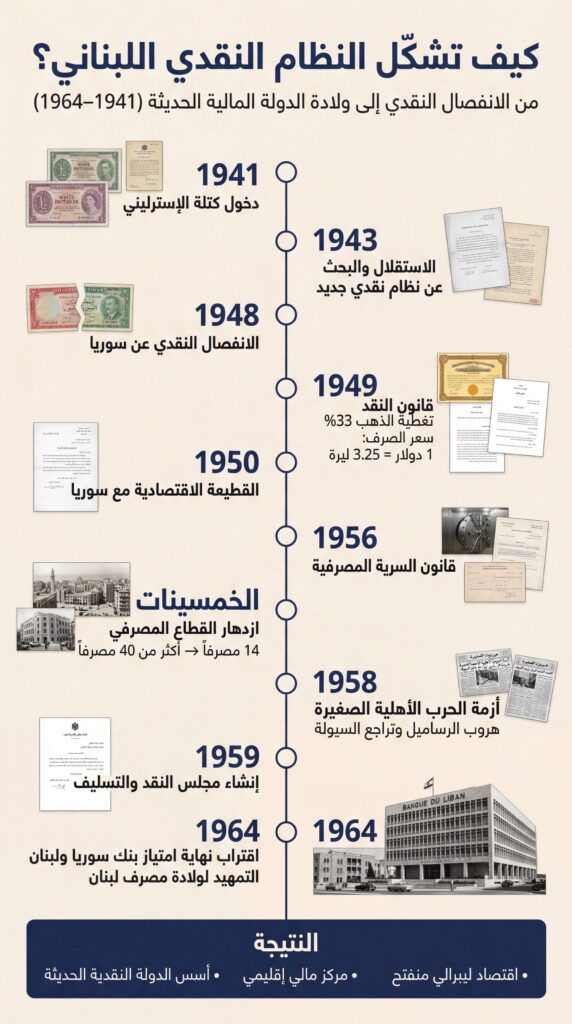
From the Second World War to the mid-1960s, Lebanon’s monetary and banking structures underwent profound changes that laid the foundations of the modern financial system. This was not a simple process of gradual economic development, but a complex path in which regional politics and domestic economic decisions were deeply intertwined.

In the summer of 1941, after General de Gaulle’s forces removed the Vichy authorities and brought Lebanon and Syria into the sterling area, the Lebanese lira was linked to the pound sterling in an attempt to preserve monetary stability amid the collapse of France’s financial system. Following independence in 1943, the Lebanese state began seeking a more autonomous currency arrangement, removed from French volatility.

By the end of the 1940s, Lebanon had chosen a decisive monetary course. A separate agreement with France in 1948 effectively separated the Lebanese lira from the Syrian lira. Domestic measures included liberalizing the foreign-exchange market, fixing the lira against the dollar and increasing gold coverage, which strengthened confidence in the currency.

This course also produced economic tension with Syria, culminating in a customs break in 1950 and disruption to the circulation of currency between the two countries, particularly during the “forty million lira” crisis and changes to their currency-issuance systems.

Lebanon entered a very different phase during the 1950s. Under President Camille Chamoun’s liberal economic policy, Beirut became a regional financial and commercial center. The transformation was driven by remittances, capital displaced after the Palestinian Nakba, emerging Gulf oil wealth and Lebanon’s relative stability compared with other countries in the region.

The 1956 banking-secrecy law was another pivotal development. It attracted foreign capital and accelerated the sector’s growth, raising the number of banks from 14 to more than 40 within a few years.

Yet rapid growth came without adequate supervision or regulation. The crises of 1956 and 1958 exposed the system’s fragility as banks faced deposit withdrawals and capital flight, forcing the issuing bank to inject substantial liquidity to maintain stability.

After the 1958 crisis, fundamental reform became unavoidable. President Fouad Chehab began rebuilding state institutions, especially in the financial and monetary spheres. He refused to renew the old arrangements with Banque de Syrie et du Liban and insisted on creating an independent central bank with authority over monetary policy.

At the government’s request, expert Joseph Oughourlian drafted the Code of Money and Credit despite objections from the Association of Banks, which feared restrictions on its members’ activity. The law passed on August 1, 1963, establishing the first comprehensive framework for banking regulation and creating Banque du Liban as an autonomous public institution.

The law gave the central bank three main duties: issuing currency, regulating liquidity and credit, and maintaining exchange-rate stability. It also imposed new rules on banks, including higher minimum-capital requirements and a transitional period for compliance.

Philippe Takla was appointed Banque du Liban’s first governor on September 7, 1963, together with his vice-governors, beginning the practical construction of the modern monetary authority. Work also started on the bank’s new Hamra headquarters, designed as the home of a sovereign and technically advanced institution.

By 1964, when the old issuing concession expired, Lebanon had completed a long transition from a fragmented monetary order to a regulated central system. It had laid the foundations of an advanced financial economy, even as structural weaknesses that would emerge later remained within it.

In the summer of 1941, Free French leader General Charles de Gaulle brought Lebanon and Syria into the sterling area after Vichy French forces were removed, linking the lira directly to the pound sterling. France was experiencing wartime economic and financial collapse, prompting Lebanese authorities after independence in 1943 to seek a more stable alternative to a monetary system based on the weakening French franc.

According to economists who witnessed the period, representatives of Lebanon, Syria, France and Britain met repeatedly in Beirut, Damascus and Chtaura to transfer the currency guarantee from the French franc to sterling reserves. Lebanese minister Hamid Frangieh and Syrian prime minister Khalid al-Azm were among the prominent political and economic figures in those negotiations.

The two countries' political and economic interests gradually diverged. On February 6, 1948, Lebanon signed a separate monetary agreement with France that effectively separated the Lebanese lira from the Syrian lira. The decision caused serious tension with Damascus, particularly after Lebanese authorities gave residents only a very short time to exchange Syrian lira circulating in Lebanon.

Despite the political tension with Syria, Lebanon chose a more open economic policy. President Bechara El Khoury reaffirmed economic and commercial freedom; the foreign-exchange market was liberalized; and the 1949 Monetary Law raised gold coverage to 33 percent of the money supply. The lira was also fixed at 3.25 pounds to the US dollar.

These policies strengthened confidence in the Lebanese currency and led many holders of Syrian lira to move their funds to Lebanon, increasing pressure on the Syrian economy. Only one year after monetary separation, the Lebanese lira had appreciated by 12 percent against its Syrian counterpart.

Meanwhile, the crisis known as the 'forty million lira' affair erupted when large quantities of Syrian currency appeared in the Lebanese market. Damascus responded by closing the border, prohibiting Syrian lira from entering, and issuing a new currency. In 1950, Syrian prime minister Khalid al-Azm formalized the economic and customs break with Lebanon.

Despite this sharp separation, Lebanon entered a period of rapid economic growth during the 1950s, particularly under President Camille Chamoun, who adopted a liberal and Western-oriented policy. Beirut benefited from its role as an open center for trade, services and finance while the Arab region experienced military coups, nationalization policies and repeated political unrest.

Remittances from emigrants flowed into Lebanon, alongside Palestinian capital after the 1948 Nakba and Gulf funds linked to the beginnings of the oil boom. The 1956 banking-secrecy law, proposed by MP Raymond Eddé, also played a decisive role in turning Lebanon into a regional financial center.

Within a few years, the banking sector expanded dramatically: the number of banks rose from 14 in 1950 to more than 40. Yet this rapid growth took place with almost no monetary regulation or supervision. There was no modern Code of Money and Credit and no effective authority overseeing bank operations.

This structural weakness became clear during the 1956 Suez Crisis, when Lebanese banks faced panic and heavy deposit withdrawals. Banque de Syrie et du Liban had to inject an estimated forty million lira in additional liquidity to rescue the sector.

The events of 1958, often called the 'little civil war,' exposed the system's fragility even further. Capital fled, liquidity declined and the economy was widely paralyzed as US Marines landed in Lebanon.

After the crisis, President Fouad Chehab recognized the need to reorganize the state and its financial and monetary institutions. A negative assessment of the Lebanese economy by International Monetary Fund envoy Kasing reinforced his conviction that reform was necessary.

The Money and Credit Council was therefore created in 1959 to prepare a modern law regulating the financial and banking sector. It was a foundational step toward a modern financial state, as the 1964 expiry of Banque de Syrie et du Liban's currency-issuance concession approached and paved the way for Banque du Liban to emerge as an independent monetary authority.

Lebanon's monetary development was therefore not merely a technical economic process. It directly reflected the political, regional and international transformations experienced by Lebanon and its surroundings. The Lebanese model took shape between economic liberalism and reformist ambition, combining financial freedom with structural fragility—an equation that would profoundly influence the country's economic history for decades.

After the end of the Lebanese Civil War, Lebanon entered a phase of reconstruction led by Rafic Hariri, with an effort to build a modern economy. During this period, the Lebanese pound was pegged to the US dollar, creating an appearance of stability. In reality, however, the economy relied heavily on debt and inflows of foreign currency.

In 2005, Hariri's assassination marked a major turning point. Confidence declined, and Syrian forces withdrew from Lebanon. Despite these changes, the monetary system continued along the same path, relying on the fixed exchange rate.

Between 2011 and 2018, Lebanon was affected by the spillover from the Syrian war. Investments declined and public debt increased. Banque du Liban resorted to complex financial policies to maintain stability, but that stability was fragile.

In 2019, with the outbreak of the 2019 Lebanese protests, the real crisis began. People lost trust in the banking system, and the Lebanese pound started to rapidly depreciate.

In 2020, the government defaulted on its debt, followed by the Beirut Port Explosion, which worsened the situation and deepened the economic collapse.

During 2021 and 2022, Lebanon experienced high inflation and multiple exchange rates, leading to a near breakdown of the monetary system.

From 2023 to 2026, a new economic reality took hold: a dollarized, cash-based economy, with the Lebanese pound losing its role as a store of value.

In conclusion, the collapse of the Lebanese pound was not sudden, but rather the result of years of unsustainable policies that masked the fragility of the economy until the moment it finally unraveled.