
From Reconstruction to Debt: The Struggle to Manage Public Debt
Riad Salameh’s mission after taking office as governor of Banque du Liban was not limited to stabilizing the exchange rate. Emerging from the war, Lebanon faced a major financial challenge: how could it rebuild its economy and finance the state’s needs without allowing public spending to place renewed pressure on the lira and monetary stability?
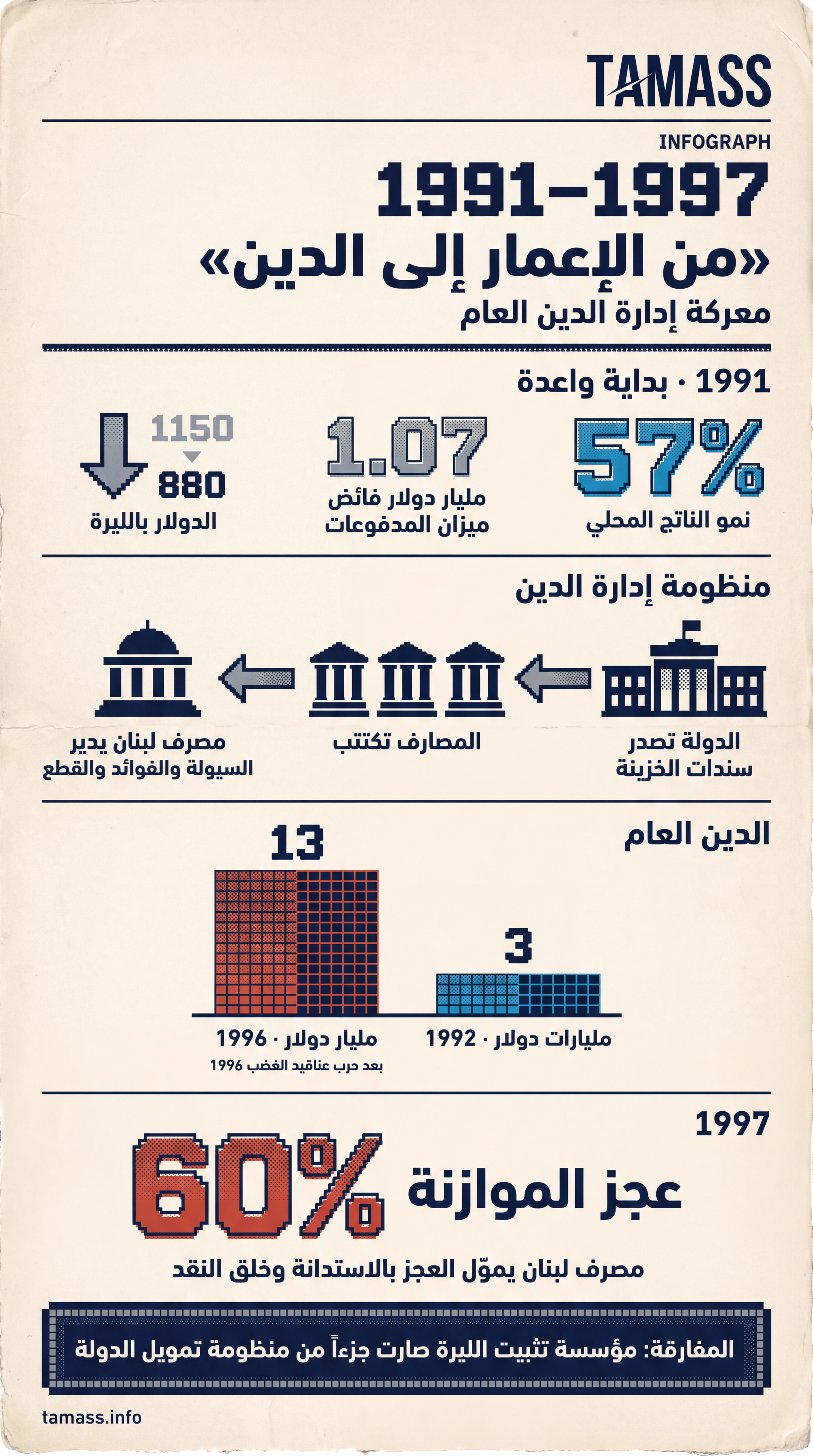
At the beginning of the 1990s, the outlook appeared promising. Following the reunification of Beirut and the easing of tensions, capital began flowing into the country and the reconstruction process got underway. GDP grew by 57% in 1991, while the balance of payments recorded a surplus of more than $1.07 billion. Meanwhile, the dollar fell from 1,150 to 880 Lebanese pounds.
Reconstruction, however, required substantial spending, while the country’s public finances remained burdened by the legacy of the war.
Against this backdrop, public-debt management emerged as one of the most significant financial challenges of the new era.
Managing the debt did not mean that Banque du Liban financed the state on its own. Rather, it relied on a broader system involving the government, commercial banks and the central bank. The government issued Treasury bills, commercial banks subscribed to them, and Banque du Liban intervened in the market to manage liquidity, interest rates and foreign exchange through the purchase of government securities, the issuance of certificates of deposit and other monetary instruments.
The central challenge was to strike a balance between the state’s financing needs and the necessity of maintaining the stability of the lira.
By the mid-1990s, achieving that balance had become increasingly difficult.
Following the 1996 “Grapes of Wrath” conflict and amid growing political and social tensions, public debt rose from approximately $3 billion in 1992 to $13 billion in 1996.
As public spending continued and debt-servicing costs increased, the budget deficit reached approximately 60% in 1997.
Banque du Liban then returned to a more sensitive position within the financing process. As the market became increasingly unable to absorb the state’s borrowing needs, the central bank was compelled to finance the deficit through borrowing and money creation—a policy that exposed it to widespread criticism.
This revealed a fundamental contradiction: the institution responsible for stabilizing the exchange rate and safeguarding monetary stability had simultaneously become a central component of the system used to finance the state and manage its debt.
Whenever the state required additional financing, Banque du Liban had to balance the need to provide liquidity against the risk that this liquidity would place further pressure on the lira and interest rates.
Lebanon therefore shifted gradually from post-war reconstruction to an increasing dependence on borrowing and rising public debt. This marked the beginning of a complex financial relationship between the state, commercial banks and Banque du Liban—a relationship that would later become one of the defining pillars of Lebanon’s financial model.
All articles