From Buying Time to Default
How Did Lebanon Reach Sovereign Default?
Lebanon did not suddenly decide to stop repaying its debt in March 2020. What was popularly described as the state’s “bankruptcy” was, financially speaking, the country’s first sovereign default since independence, resulting from years of accumulated imbalances that ultimately erupted amid a collapse in confidence and liquidity.
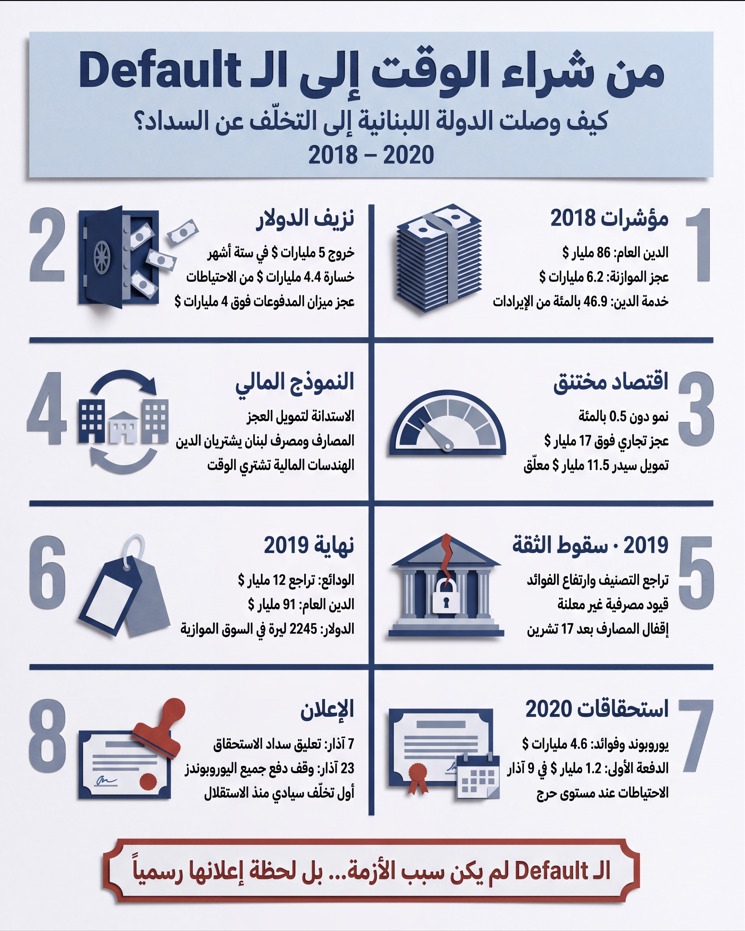
In 2018, the warning signs of the financial model’s growing strain became increasingly clear. Reforms required to secure approximately $11.5 billion in financing through the CEDRE conference remained stalled, while capital outflows accelerated. Between May and November, around $5 billion left Lebanon, and Banque du Liban lost $4.4 billion in foreign currency reserves.
Economic indicators reflected the depth of the crisis: growth fell below 0.5%, the trade deficit exceeded $17 billion, and the balance-of-payments deficit surpassed $4 billion. Public debt reached $86 billion, while interest payments consumed 46.9% of government revenues. The budget deficit stood at $6.2 billion, equivalent to 11.4% of GDP.
The state increasingly relied on commercial banks and Banque du Liban to finance its deficits, while maintaining the currency peg required continuous inflows of dollars. Financial engineering operations provided temporary liquidity and bought time, but failed to address the underlying problems: high public spending, insufficient revenues, a weak productive economy, and repeatedly postponed reforms.
Throughout 2019, mounting concerns developed into an open crisis of confidence. Credit ratings deteriorated, Eurobond yields increased, and capital outflows accelerated. Banks began imposing unofficial restrictions on withdrawals and transfers. Their closure following the October 17 protests dealt another severe blow to the remaining public confidence.
By the end of the year, deposits had fallen by $12 billion, public debt had reached $91 billion, and the balance-of-payments deficit exceeded $5 billion. The dollar ended the year at 2,245 Lebanese pounds on the parallel market.
In early 2020, the government faced $4.6 billion in Eurobond principal and interest payments, including a $1.2 billion bond maturing on March 9. With foreign currency reserves reaching critically low levels and opinions divided between meeting debt obligations and preserving liquidity for essential needs, Lebanon approached its most difficult decision.
On March 7, the government announced that it would suspend payment on the maturing bond. On March 23, it decided to suspend payments on all Eurobonds. For the first time since independence, Lebanon officially entered sovereign default.
Default was not the cause of Lebanon’s crisis, but the moment it was formally acknowledged: the result of accumulated debt, chronic deficits, a costly currency peg, dependence on dollar inflows, and reforms delayed until time had run out.
All articles