
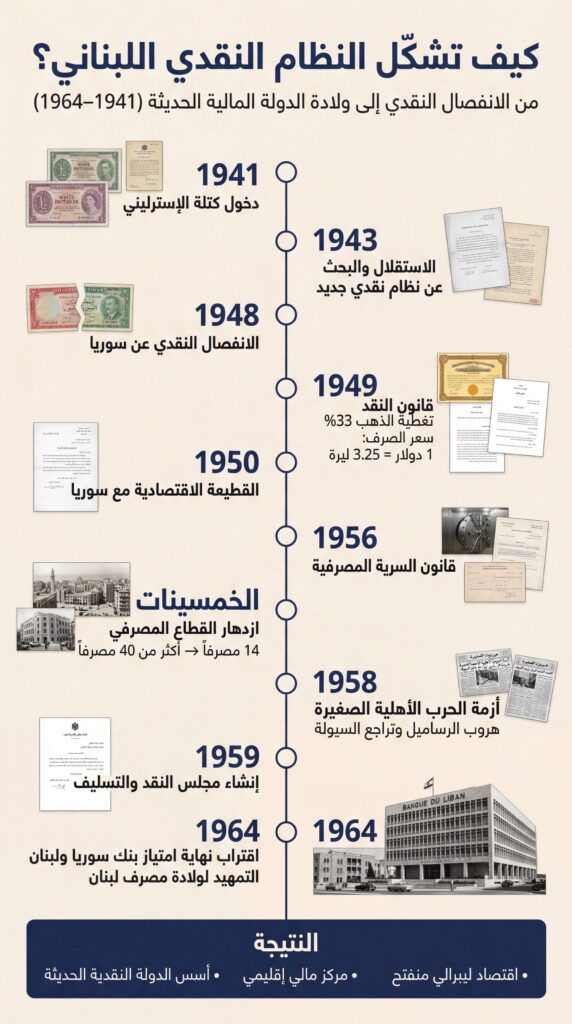
In the summer of 1941, Free French leader General Charles de Gaulle brought Lebanon and Syria into the sterling area after Vichy French forces were removed, linking the lira directly to the pound sterling. France was experiencing wartime economic and financial collapse, prompting Lebanese authorities after independence in 1943 to seek a more stable alternative to a monetary system based on the weakening French franc.
According to economists who witnessed the period, representatives of Lebanon, Syria, France and Britain met repeatedly in Beirut, Damascus and Chtaura to transfer the currency guarantee from the French franc to sterling reserves. Lebanese minister Hamid Frangieh and Syrian prime minister Khalid al-Azm were among the prominent political and economic figures in those negotiations.
The two countries' political and economic interests gradually diverged. On February 6, 1948, Lebanon signed a separate monetary agreement with France that effectively separated the Lebanese lira from the Syrian lira. The decision caused serious tension with Damascus, particularly after Lebanese authorities gave residents only a very short time to exchange Syrian lira circulating in Lebanon.
Despite the political tension with Syria, Lebanon chose a more open economic policy. President Bechara El Khoury reaffirmed economic and commercial freedom; the foreign-exchange market was liberalized; and the 1949 Monetary Law raised gold coverage to 33 percent of the money supply. The lira was also fixed at 3.25 pounds to the US dollar.
These policies strengthened confidence in the Lebanese currency and led many holders of Syrian lira to move their funds to Lebanon, increasing pressure on the Syrian economy. Only one year after monetary separation, the Lebanese lira had appreciated by 12 percent against its Syrian counterpart.
Meanwhile, the crisis known as the 'forty million lira' affair erupted when large quantities of Syrian currency appeared in the Lebanese market. Damascus responded by closing the border, prohibiting Syrian lira from entering, and issuing a new currency. In 1950, Syrian prime minister Khalid al-Azm formalized the economic and customs break with Lebanon.
Despite this sharp separation, Lebanon entered a period of rapid economic growth during the 1950s, particularly under President Camille Chamoun, who adopted a liberal and Western-oriented policy. Beirut benefited from its role as an open center for trade, services and finance while the Arab region experienced military coups, nationalization policies and repeated political unrest.
Remittances from emigrants flowed into Lebanon, alongside Palestinian capital after the 1948 Nakba and Gulf funds linked to the beginnings of the oil boom. The 1956 banking-secrecy law, proposed by MP Raymond Eddé, also played a decisive role in turning Lebanon into a regional financial center.
Within a few years, the banking sector expanded dramatically: the number of banks rose from 14 in 1950 to more than 40. Yet this rapid growth took place with almost no monetary regulation or supervision. There was no modern Code of Money and Credit and no effective authority overseeing bank operations.
This structural weakness became clear during the 1956 Suez Crisis, when Lebanese banks faced panic and heavy deposit withdrawals. Banque de Syrie et du Liban had to inject an estimated forty million lira in additional liquidity to rescue the sector.
The events of 1958, often called the 'little civil war,' exposed the system's fragility even further. Capital fled, liquidity declined and the economy was widely paralyzed as US Marines landed in Lebanon.
After the crisis, President Fouad Chehab recognized the need to reorganize the state and its financial and monetary institutions. A negative assessment of the Lebanese economy by International Monetary Fund envoy Kasing reinforced his conviction that reform was necessary.
The Money and Credit Council was therefore created in 1959 to prepare a modern law regulating the financial and banking sector. It was a foundational step toward a modern financial state, as the 1964 expiry of Banque de Syrie et du Liban's currency-issuance concession approached and paved the way for Banque du Liban to emerge as an independent monetary authority.
Lebanon's monetary development was therefore not merely a technical economic process. It directly reflected the political, regional and international transformations experienced by Lebanon and its surroundings. The Lebanese model took shape between economic liberalism and reformist ambition, combining financial freedom with structural fragility—an equation that would profoundly influence the country's economic history for decades.
All articles